

Key Takeaways:
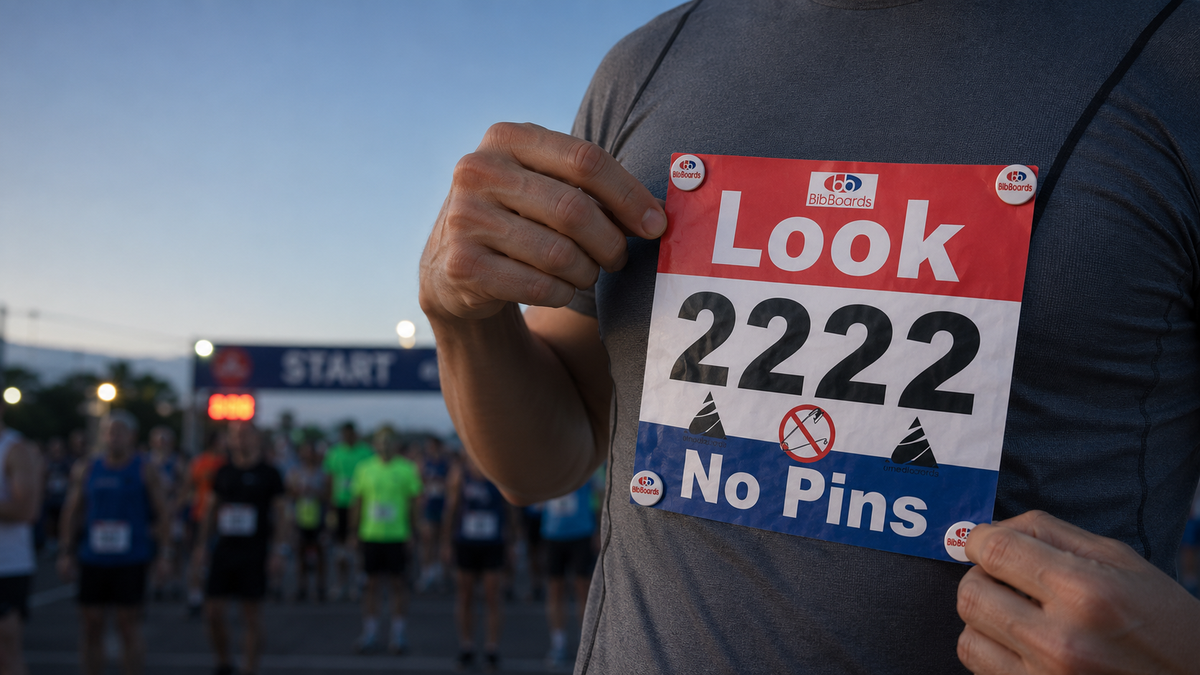
- Put it on the front of your torso, centred, with the bottom edge roughly at the bottom of your ribcage.
- Fasten all four corners. Two corners is the reason bibs flap.
- Do not fasten through the timing chip, the foam square on the back. That is how people end up with no recorded time.
- Attach it with the shirt off, laid flat. Not while you are wearing it.
- Do not put it on your leg, back, or shorts unless the race instructions say so.
- And the honest bit: you do not have to pin it at all. Pins are just what was in the packet.

The correct position, precisely
Race bibs go on the front of the torso. Not the back, not the thigh, not clipped to your shorts, unless the race instructions specifically say otherwise. Triathlon is the main exception, and the rules there will tell you.
Within "the front of your torso" there is a right answer and it is narrower than most people think:
- Centred left to right. Off to one side and it catches your arm swing on that side.
- Bottom edge around the bottom of your ribcage. High enough that the bib is not folding over your waistband when you drive a knee up, low enough that it is not sitting on your chest where the fabric moves most as you breathe.
- Flat, not curved around your body. A bib fastened across the curve of your side will crease down the middle within a mile.
The practical test is the finish photo. Photographers and timing marshals both want to read the number without you doing anything. If your number is readable in a photo taken from head height, ten metres away, while you are mid-stride, you have it right.
Why all four corners matter
This is the single most common mistake, and it is the reason for almost every flapping-bib complaint.
Two fasteners at the top corners leave the bottom edge free. Once air gets under that edge, at any speed, the bib lifts and slaps. It also folds, which makes the number unreadable at exactly the moment it needs reading.
Four corners removes the problem completely, because there is nowhere for air to get underneath and no pivot point for the bib to rotate around. If you are using pins, use four. If you are using a fastener system, a set is four pieces for exactly this reason.
The timing chip mistake
Turn your bib over before you attach anything.
On most modern race bibs the timing chip is a small foam-backed tag stuck to the reverse, usually near the bottom edge or in a corner. It is thin and easy to miss.
Two things to avoid:
- Do not put a pin through it. Piercing the antenna can stop it reading. You will not know until results are published.
- Do not press a magnet against it. This is the risk with magnetic bib holders. Strong magnets sitting directly on a timing chip are a gamble taken for the entire race, with an invisible failure mode.
If the chip is in a corner, fasten just inside it rather than through it. A centimetre of clearance is plenty.
Attach it before you put the shirt on

Lay the shirt flat on a table or a car boot, position the bib, and fasten it there.
Attaching a bib to a shirt you are already wearing is how people pinch skin, and it is how bibs end up crooked. When you pinch the fabric on your body you are pinching a fold that exists because of how you are standing. Stand up straight and the fold disappears, taking the bib's alignment with it.
It also takes longer. The whole job takes under a minute laid flat, and several minutes and some swearing done on your own chest in a cold car park.
What about the pins themselves?
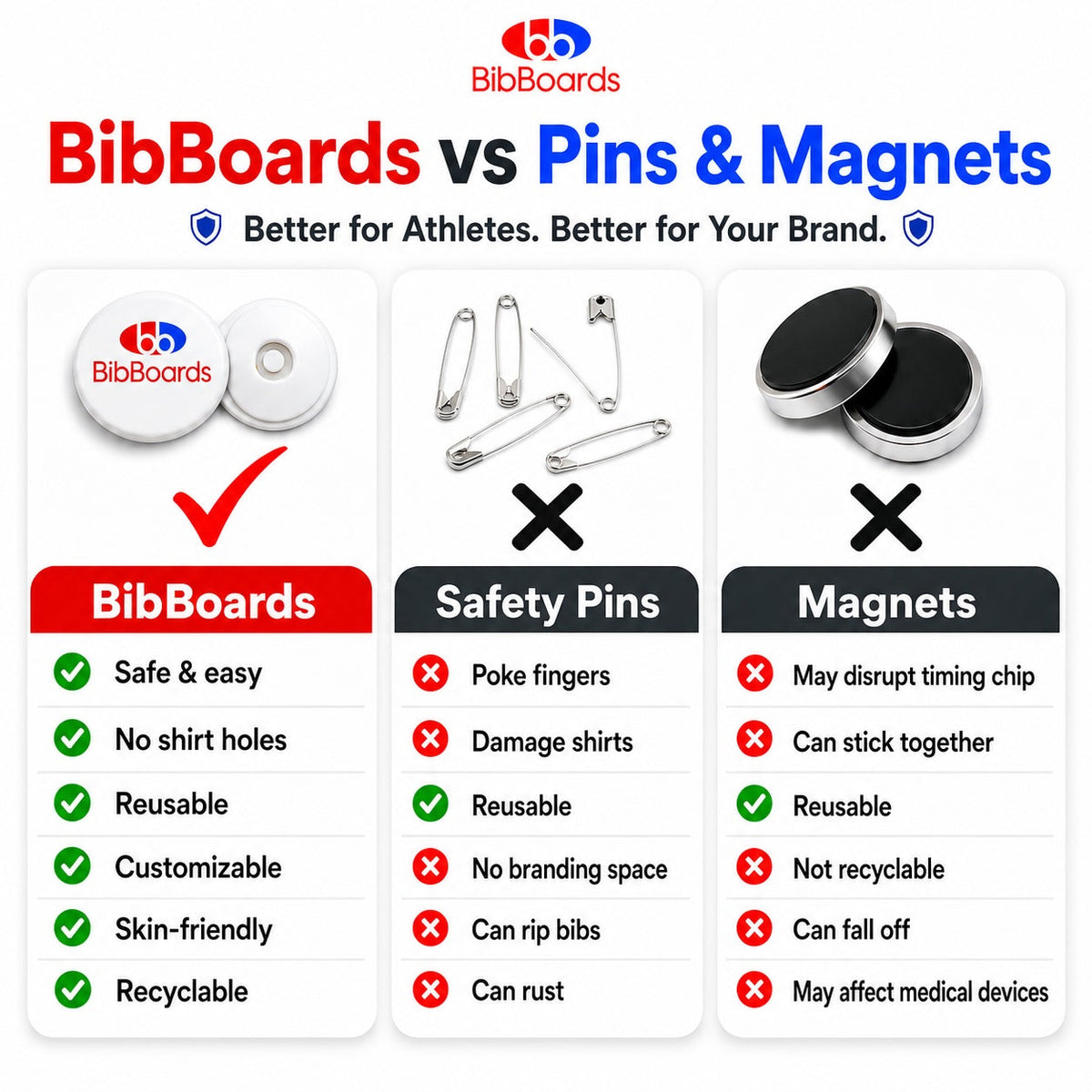
Here is the part nobody says out loud at packet pickup: the four safety pins in your race packet are not there because they are the best tool. They are there because they are cheap and because they always have been.
They have specific downsides:
- Four permanent holes per race. Technical fabric does not close back up the way cotton does. Every race leaves marks on a shirt you paid for.
- A pivot point at each corner. A pin pierces a single spot, so the bib can rotate around it even when all four are used.
- A shredded bib. If you keep bibs from goal races, pins are why the corners are torn.
- Rust marks if you leave them in a sweaty shirt in a kit bag overnight.
None of that is a disaster. It is just a small tax you pay at every race for no particular reason.
How to attach a bib without pinning it
A snap-and-lock fastener is two smooth pieces. One goes behind the corner of the bib and behind the shirt fabric, the other snaps onto it from the front, and the two push a small fold of bib and fabric into a recess. The fold is what holds.
Because nothing pierces anything, there are no holes, no torn bib corners, and no pivot point. There is no metal and no magnet, so the timing chip is unaffected. After the race they pop off in a second and go back in the bag.
Four steps:
- Lay the shirt flat and position the bib where you want it.
- Put a base piece behind each of the four corners.
- Snap the top pieces on.
- After the race, pop them off and keep them for next time.
Full walkthrough with photos: how bibSNAPS work. Or see the pin-free overview if you want the reasoning first.
Special cases
- Triathlon. Bib to the back on the bike, to the front on the run. A race belt is the standard answer because you spin it in transition rather than refastening.
- Trail and ultra. Wind and pack straps both attack a bib. Four corners is not optional here, and many runners move the bib to a pack strap or a leg band, which the race will usually permit. Check the rules.
- Cold-weather layers. Fasten the bib to your outermost layer, and accept you will have to move it if you strip a layer at mile ten. A reusable fastener makes that a ten-second job rather than a repin.
- Very thin racing singlets. The lighter the fabric, the more a pinned bib pulls and distorts it. This is where hole-free fasteners are most obviously better.
Frequently asked questions
Where exactly should a race bib go?
On the front of your torso, centred left to right, with the bottom edge roughly level with the bottom of your ribcage. It should sit flat and be readable from ten metres away.
Should a race bib go on your shirt or your shorts?
Your shirt, on the front of the torso, unless the race instructions say otherwise. A bib on shorts folds with every stride and is difficult for timing marshals to read.
How many pins do you need for a race bib?
Four, one at each corner. Using two is the most common cause of a bib that flaps and folds during a race.
Can you wear a race bib on your back?
Only if the race asks you to. Some triathlons require the bib on the back for the bike leg. For road running the number needs to be visible on the front.
Will pinning through the timing chip ruin my result?
It can. The chip is usually a foam-backed tag on the reverse of the bib, and piercing the antenna can stop it registering. Fasten just inside the chip rather than through it.
Do I have to use the pins the race gave me?
No. Races require your number to be visible on the front of your body with the timing chip unobstructed. How you attach it is your choice.

Leave a comment
This site is protected by hCaptcha and the hCaptcha Privacy Policy and Terms of Service apply.