

Key Takeaways:
- Yes. On technical running fabric the holes are permanent. Cotton closes back up, performance knit does not.
- Four pins per race means four holes each time, in the same general area, on shirts that cost $40 to $80.
- Pins also cause snags, ladders and rust marks, which do more visible damage than the holes themselves.
- The bib suffers too. Torn corners are why kept race bibs look ragged.
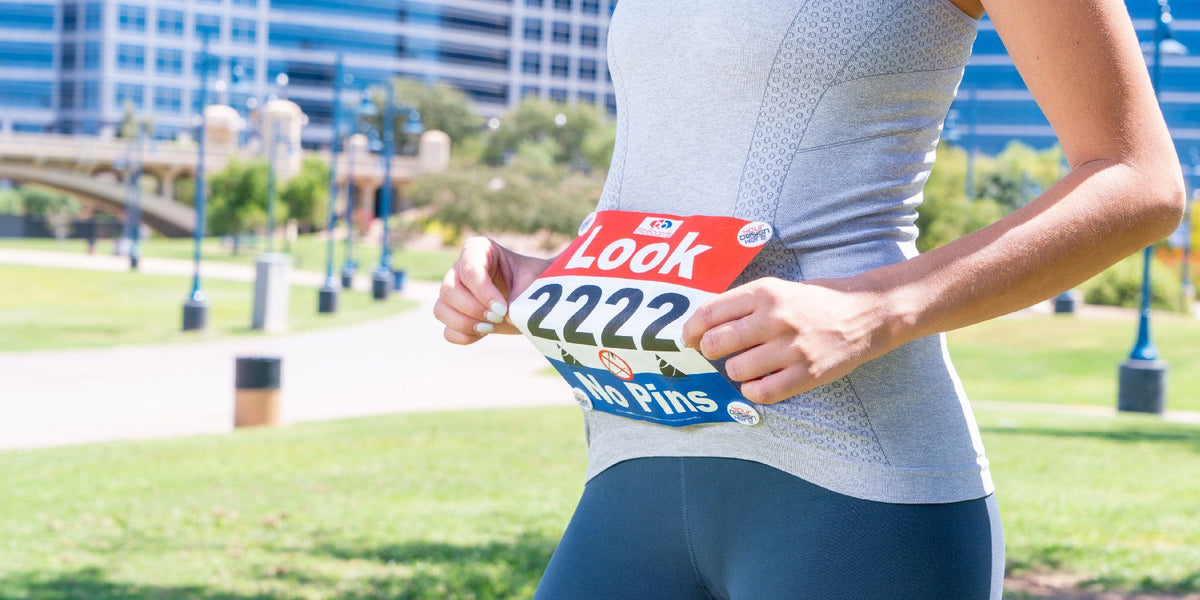
- It is avoidable. Hole-free fasteners hold the bib by pushing fabric into a recess instead of piercing it.

Why technical fabric does not recover and cotton does
This is the bit that surprises people, because most of us learned about safety pins on cotton t-shirts where they genuinely do no lasting harm.
A cotton t-shirt is a relatively loose knit of short, fluffy staple fibres. Push a pin through it and you are mostly shoving fibres aside. Wash it, and those fibres relax and migrate back. The hole closes.
A performance running shirt is a tight knit of long, smooth synthetic filaments, usually polyester, often with elastane through it. There are no loose fibre ends to drift back into the gap. When a pin goes through, it does one of two things:
- Pushes filaments permanently apart, leaving a visible open hole that stays open, or
- Breaks a filament, which in a knit means a dropped stitch. That is how a small puncture becomes a ladder running down the shirt after a few washes.
The elastane makes it worse rather than better. It is under tension in the finished garment, so once a filament is broken the surrounding fabric pulls away from the break rather than closing over it.
What four pins per race adds up to
One race is not a problem. The problem is that this is a repeated cost on a garment you wear repeatedly.
A runner doing one race a month for a season puts around forty holes into their racing kit in a year, almost all of them in the same band across the front of the shirt. Race shirts also tend to be the ones you like most, because they are the light ones you save for race day.
And it is not only the holes:
- Snags and pulls. The pin catches a filament as it goes through and drags it, leaving a pulled loop on the outside. On smooth fabric this is more visible than the hole.
- Rust marks. Leave pinned bibs in a sweaty shirt in a kit bag overnight and cheap plated pins mark the fabric. Rust on polyester does not always wash out.
- Stretched pin points. The bib pulls on four small points for the length of the race. On a lightweight singlet the fabric around each pin visibly distorts.
- Wash-cycle spread. A broken filament that looks fine on race day is a visible run three washes later.
Are safety pins actually unsafe?

For clothing, "unsafe" is the wrong word. They are destructive rather than dangerous.
For people, there is a modest, real safety case, which is mostly about volume and context:
- Pricked fingers at packet pickup and at the start. Cold hands and small pins is a bad combination, and it happens at scale, several thousand times at a big event.
- Pins that open mid-race. An open pin against skin, under a bib, for several miles.
- Pins on the ground. Start and finish areas end up scattered with them, which matters at events with barefoot warm-ups, children, or dogs.
- Volunteers handling them by the thousand while stuffing packets.
None of these is a serious hazard on its own. Multiplied by the number of runners at a large event, they become a predictable stream of small injuries and a genuine tidy-up problem.
What about the bib?
If you keep your race bibs, pins are the reason the ones from your best races look the worst. Four pierced corners, usually torn out at least partly during the race as the bib pulls against them.
Race bibs are printed on Tyvek or a similar tear-resistant material precisely so they survive a race. They resist tearing well, but a pin creates an initiating point, and material that would never tear on its own will tear from a hole.
How to stop doing it
The fix is to hold the bib without piercing anything.
A snap-and-lock fastener is two smooth pieces. A base sits behind the corner of the bib and the shirt fabric. A top piece snaps onto it from the front. Together they push a small fold of bib and fabric down into a recess, and that fold is what holds it in place.
Because the grip comes from the shape rather than from a puncture:
- There are no holes and no snagged filaments, so the shirt is unchanged after the race.
- There is no pin point for the bib to pull against, so no stretched fabric and no torn bib corners.
- There is no metal to rust into the fabric in a kit bag.
- There is nothing sharp against your skin for the duration of the race.
- They come off in a second afterwards and get used again at the next race.
There is also no magnet involved, which matters because the other popular hole-free option, magnetic bib holders, introduces a chip-timing risk in exchange for solving the fabric problem.
See how it works step by step, or read the full pin-free explainer.
If you are stuck with pins today
Sometimes it is race morning and pins are what you have. To limit the damage:
- Use all four corners. Fewer pins means more force on each one, which means more distortion and more tearing.
- Pin through the shirt hem or a seam where you can. Seams are denser and already stitched, so a hole there is far less visible.
- Go in and straight back out with the smallest bite of fabric possible. A long pass through the fabric drags more filaments.
- Take them out the moment you finish. This is the single easiest way to avoid rust marks.
- Never pin through the timing chip, the foam-backed square on the reverse of the bib.
Frequently asked questions
Do safety pin holes in a running shirt go away?
On cotton, largely yes. On technical polyester or nylon running fabric, no. The filaments are smooth and continuous, so there are no loose fibre ends to close the gap, and the hole stays.
Can you repair pin holes in technical fabric?
Not invisibly. A small hole can be stabilised from the inside with fusible mending tape to stop it laddering, but the fabric structure at that point is permanently broken.
Do safety pins cause rust stains on running shirts?
Cheaper plated pins can, especially if left in a damp shirt in a kit bag. Rust marks on synthetic fabric are often permanent.
Are safety pins dangerous for runners?
Individually, not really. At the scale of a large event they produce a steady stream of pricked fingers, occasional open pins against skin during a race, and a lot of loose pins on the ground in start and finish areas.
What can I use instead of safety pins for a race bib?
Snap-and-lock bib fasteners, a race belt, magnetic holders or bib clips. Snap-and-lock fasteners are the only option that removes the holes without introducing a chip-timing risk.
Will bib fasteners damage my shirt?
No. Nothing pierces the fabric. The bib is held by a fold of material pressed into a recess, and both the shirt and the bib come away unmarked.

Leave a comment
This site is protected by hCaptcha and the hCaptcha Privacy Policy and Terms of Service apply.