
Key Takeaways
- Every croc charm works the same way. A short peg on the back pushes through a hole in the shoe and widens behind it, so the charm holds without glue or a clasp.
- There are three real ways to make one: moulded soft PVC, printed or cut acrylic, and handmade clay or resin. They are not interchangeable.
- Clay and resin are genuinely doable at home for one or two charms. They are slow, and consistency across a batch is the thing that defeats most people.
- Commercial charms are moulded soft PVC because it holds a shape, takes matched colour, and survives a school day without snapping.
- Custom moulded charms start at 25 pieces, 1 to 1.25 inches, with a free digital mock-up inside 24 hours and your approval before anything is produced.
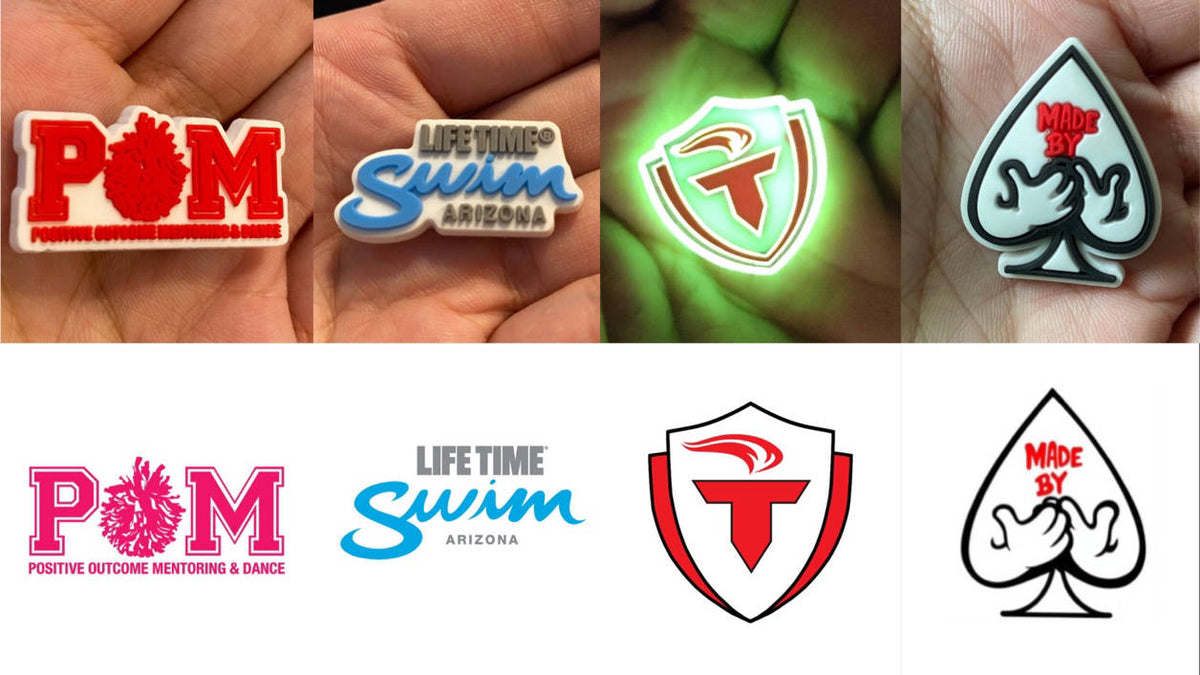
What a croc charm actually is
Strip away the shape and a croc charm is a fastener. On the back there is a short peg with a wider head. You push the peg through one of the holes in the shoe, the head squeezes through, and then it springs back and sits behind the material. Nothing is glued. Nothing clips. The charm is held by the thickness of the shoe itself.
That one detail explains almost everything else about how charms are made. The peg has to flex to go through the hole and then recover its shape, over and over, for the life of the charm. A material that is too rigid cracks at the neck of the peg. A material that is too soft lets the head deform until it slides back out. Anyone making a charm at home is really solving that problem, whether they realise it or not.
The three ways charms get made

Almost every charm you have ever seen came from one of three processes.
Moulded soft PVC. A steel or aluminium mould is cut for your shape, soft PVC is injected or poured in, and the charm comes out as one piece with the peg already attached. This is how commercial charms are made, including ours. The upside is that the material is flexible, holds fine outlines, takes matched colours and is consistent across thousands of pieces. The downside is the mould. Cutting one costs money and time, which is why custom moulded charms come with a minimum order rather than being sold one at a time.
Printed or cut acrylic. A flat sheet of acrylic is laser cut or printed, then a separate plastic rivet or peg is fixed to the back. You see this on novelty and fan-art charms. It is cheaper to set up because there is no mould, and the artwork can be photographic. It is also the format most likely to snap, because acrylic is rigid and the join between the backing and the sheet is a weak point.
Handmade clay or resin. Polymer clay shaped and baked, or resin poured into a silicone mould. This is the home route. It gives you a one-off with no setup cost at all, and it is genuinely fun. It is also slow, and the peg is usually the part that lets it down.
| Method | Setup cost | Per-piece cost at volume | Detail | Durability | Realistic quantity |
|---|---|---|---|---|---|
| Moulded soft PVC | Mould required | Lowest | Good on bold outlines, matched colours | High, flexes without cracking | 25 to 5,000 |
| Printed or cut acrylic | Low | Medium | Excellent, photographic | Low, rigid and prone to snapping | 1 to a few hundred |
| Polymer clay | None | High | Depends entirely on your hands | Medium, chips if dropped | 1 to 10 |
| Resin cast at home | Silicone mould | Medium | Good, bubbles are the enemy | Medium | 1 to 20 |
Making one at home, honestly
If you want to make a charm yourself, polymer clay is the sensible starting point. Here is the realistic version of the process, including the parts people leave out of short videos.
- Get the backing first. Buy blank charm pegs or rivets before you make anything. Trying to sculpt a peg out of the same clay as the charm is where most home attempts fail, because the thin neck snaps the second you flex it.
- Work to the right size. Standard charms sit between 1 and 1.25 inches. Go much bigger and the charm levers itself out of the hole when it catches on something.
- Keep the shape bold. Fine lines and small text disappear at one inch, in clay as much as in a factory. Mascots, initials, simple crests and chunky silhouettes all read well.
- Bake to the clay manufacturer's instructions, not to a number you half remember. Underbaked clay stays brittle.
- Fix the peg with an adhesive rated for plastics, and let it cure fully before you test it. This join is the single most common failure point on a homemade charm.
- Test it on the shoe you actually own, then wear it for a day before you make five more.
Resin follows a similar path with a silicone mould, with the added steps of degassing to avoid bubbles and working somewhere ventilated. If you go that route, read the safety data sheet for the specific resin rather than relying on a general tutorial.
Where home-made stops working
There is a clean line between a craft project and an order, and it is not really about skill. It is about repetition.
- Consistency. Thirty handmade charms will not match. For a gift that is charming. For a team, a school or a brand it looks like a mistake.
- Colour. Matching a specific team or brand colour by eye across a batch is close to impossible. Moulded charms are colour matched to your artwork once and then repeat exactly.
- Durability. A charm that lives on a shoe gets kicked, scraped and soaked. Clay chips and acrylic snaps. Soft PVC bends and comes back.
- Time. Clay charms take roughly as long each. Fifty of them is fifty times the work, which is usually the moment people start pricing out production.
- Safety. Small parts and young children are a real consideration, and a homemade peg that works loose is a different risk from a moulded one. We cover this properly in our guide to croc charm safety for kids.
How a custom moulded charm gets made
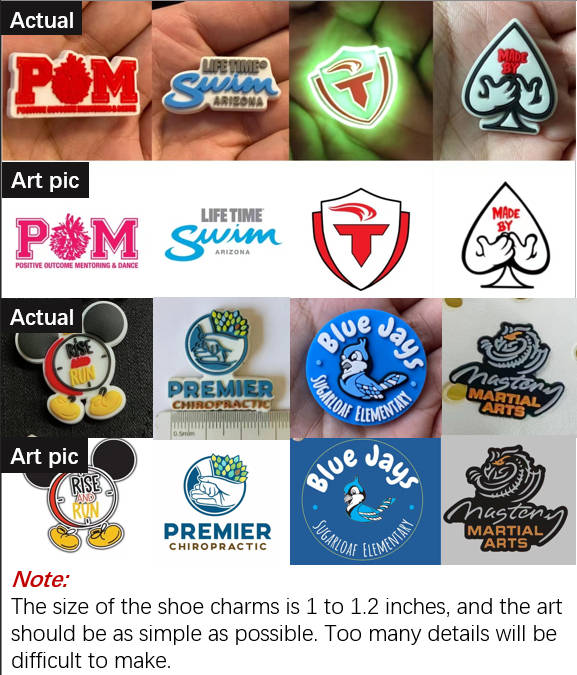
The commercial process is shorter than people expect, and the only step that needs anything from you is the first one.
- Upload your artwork on the product page. The custom shaped shoe charms page has a designer built into it. Drag your file in or click to upload, and you can see your logo, mascot or drawing on the charm before you order anything. Vector art reproduces best, but we work from what you have. If you would rather not use the tool, email the file to custom@bibboards.com instead.
- Get a free digital mock-up within 24 hours. This shows your shape and colours as they will actually be cut, not a photograph of something similar.
- Approve the proof. Nothing goes into production until you have signed it off. Colour and outline questions get settled here.
- Moulding. Your shape is produced in soft, non-toxic PVC, colour matched to the artwork, at 1 to 1.25 inches.
- Delivery. Quantities run from 25 up to 5,000 per design.
Full specification and current quantity pricing sit alongside the designer on the product page, and the bulk tiers are grouped on the custom croc charms collection.
What the material actually is
Soft PVC is the standard for charms for the same reasons it is standard for luggage tags and patches. It is flexible, it holds a moulded outline, and it takes pigment well. If you want to understand how polymers behave as a class, the National Institute of Standards and Technology keeps a plain-language overview of polymer science and measurement.
Phthalates come up often in questions about soft plastics, and reasonably so. The Consumer Product Safety Commission publishes the current rules and the list of restricted phthalates in its phthalates guidance, which is the right reference to check rather than a seller's own wording.
Frequently asked questions
Can I really make croc charms at home? Yes, for one or a few. Polymer clay plus a bought backing peg is the most reliable route. Matching a batch is the part that does not scale.
What material are commercial croc charms made of? Soft, non-toxic PVC. It flexes enough for the peg to push through the hole and recover, which rigid plastics do not.
Why do custom charms have a minimum order? Because a mould has to be cut for your shape. The mould cost is spread across the run, which is why the per-piece price falls as the quantity rises.
What size should a charm be? Between 1 and 1.25 inches. That is the size the holes in a foam clog are designed around.
Will my logo work at that size? Bold shapes, mascots, initials and simple crests reproduce well. Fine text and thin lines do not. The free mock-up shows you before you commit.
How long does a custom order take? It depends on artwork approval and quantity. Tell us your event date with the artwork and we will confirm whether it is achievable before you order.
Can I get charms that are not for Crocs? Yes. The same shape can be made as a snap charm for watch bands, bags and lanyards. Shoe charms on different shoes and surfaces covers what fits where.
Do schools need a purchase order? We accept them. Send the school details with the artwork and quantity.

Leave a comment
This site is protected by hCaptcha and the hCaptcha Privacy Policy and Terms of Service apply.