

Key Takeaways:
There are six realistic alternatives to safety pins for attaching a race bib. Ranked by how well they solve the actual problems:
- Snap-and-lock bib fasteners (bibSNAPS). No holes, no magnets, reusable, chip safe. Best all round.
- Race belt. No holes at all, but the bib sits at the waist and can spin. Standard in triathlon.
- Magnetic bib holders. No holes, quick, but carry a real chip-timing risk.
- Bib clips or toggles. No holes, but grip varies a lot by fabric.
- Tape. Free and available, but it fails in rain and sweat.
- Sew it on. Genuinely secure, genuinely absurd for one race.
If you want one answer: a snap-and-lock fastener solves the most problems at once, with no chip risk.
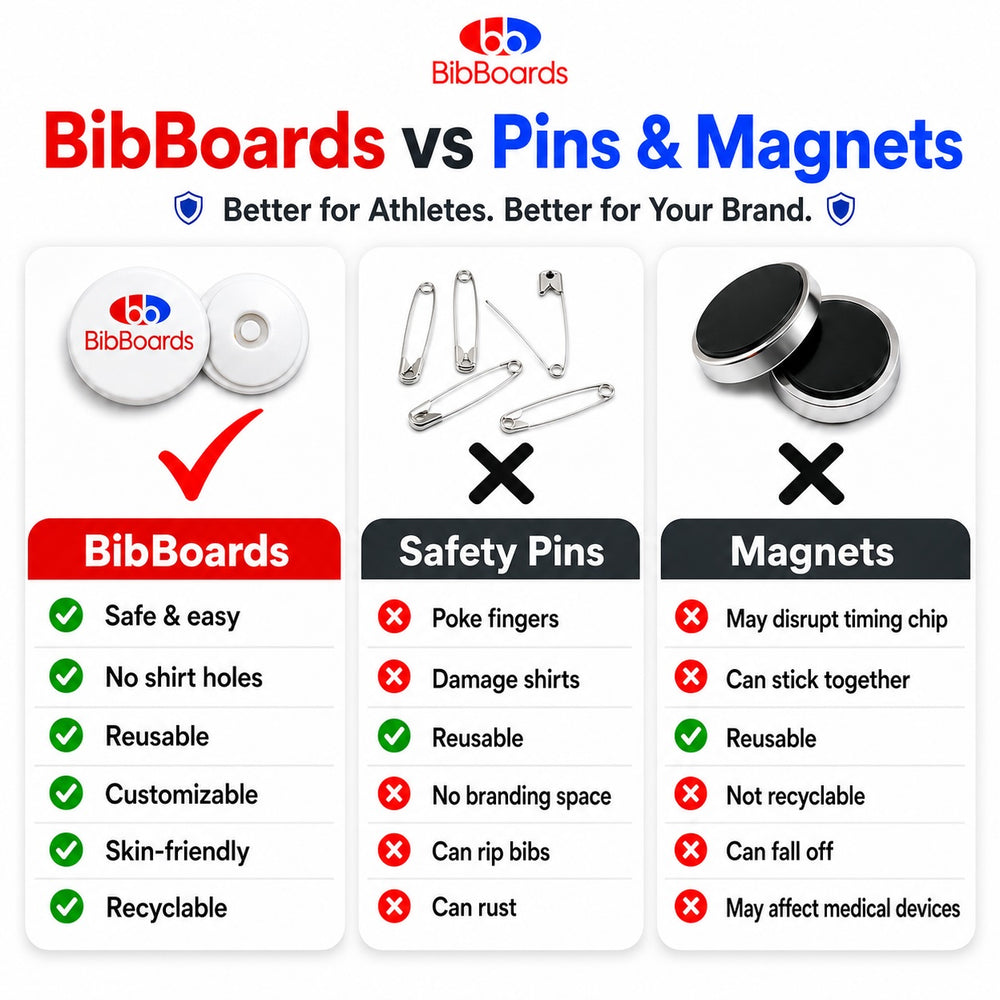
What is actually wrong with safety pins
Worth being specific, because "pins are bad" is not a reason and it makes the alternatives look interchangeable. They are not.
Pins fail on four counts:
- They make permanent holes. Technical running fabric does not close back up the way cotton does. Four holes per race, every race, in shirts that cost real money.
- They create a pivot point. Each pin pierces one spot, and the bib rotates around it. That is why bibs end up crooked and flapping.
- They are slow and fiddly. Attaching four pins to a shirt you are wearing, in the cold, before a start, is a two to four minute job that pricks fingers.
- They tear the bib. If you want to keep your bib from a goal race, pins are the reason the corners are shredded.
A good alternative has to fix the holes and the pivot problem, without introducing a new one. That last part is where most of them fall down.
The comparison
| Method | Holes | Chip safe | Grip | Reusable | Attach time | Rough cost |
|---|---|---|---|---|---|---|
| Snap-and-lock fasteners | None | Yes | Strong, four corners | Yes, indefinitely | Under 30 sec | $10 to $12 a set |
| Race belt | None | Yes | Good, but rotates at the waist | Yes | Seconds | $10 to $25 |
| Magnetic holders | None | Risk | Slides on thin fabric | Yes | Under a minute | $15 to $30 |
| Bib clips / toggles | None | Yes | Varies by fabric | Yes | About a minute | $8 to $15 |
| Tape | None | Yes | Fails when wet | No | A minute | Pennies |
| Sewing | Needle holes | Yes | Excellent | No | 15+ min | Free, plus your evening |
| Safety pins | Four per race | Yes | Pivots | In theory | 2 to 4 min | Free in the packet |
1. Snap-and-lock bib fasteners
Two smooth pieces. A base goes behind the corner of the bib and the shirt fabric, a top piece snaps onto it from the front, and the two together push a small fold of bib and fabric down into a recess. That fold is what holds it.
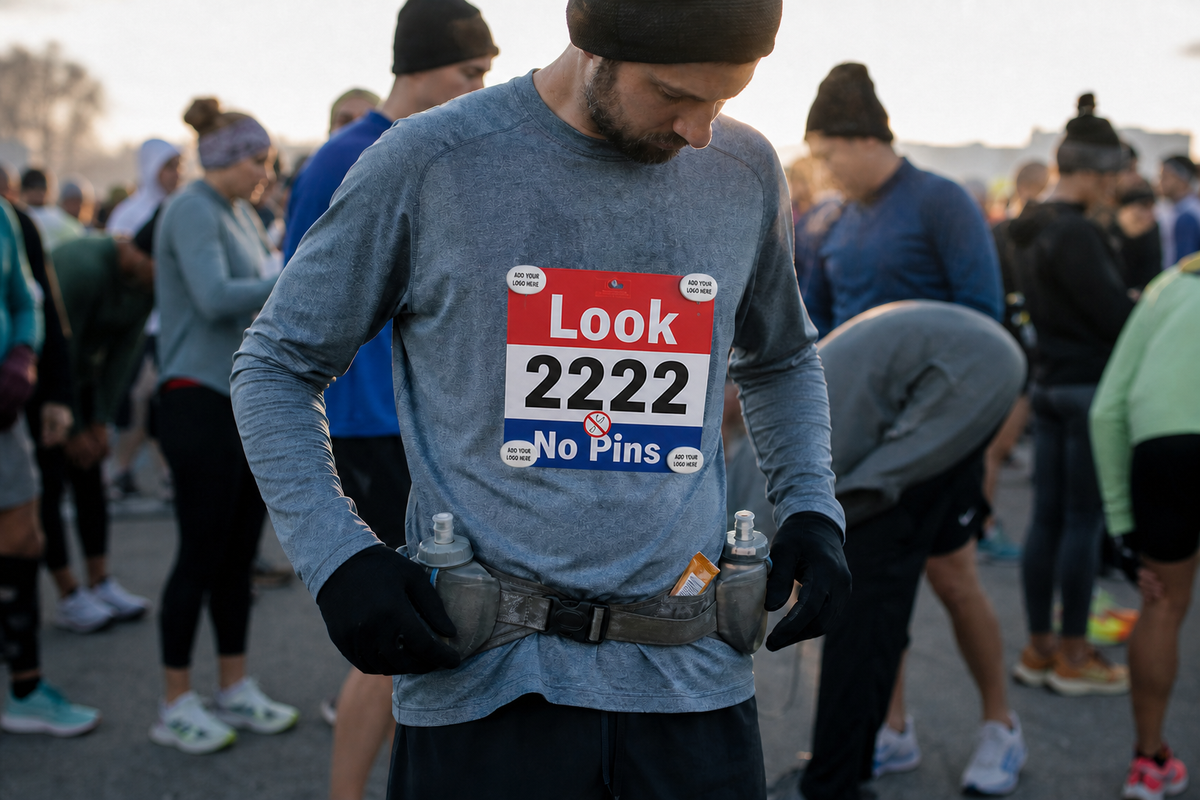
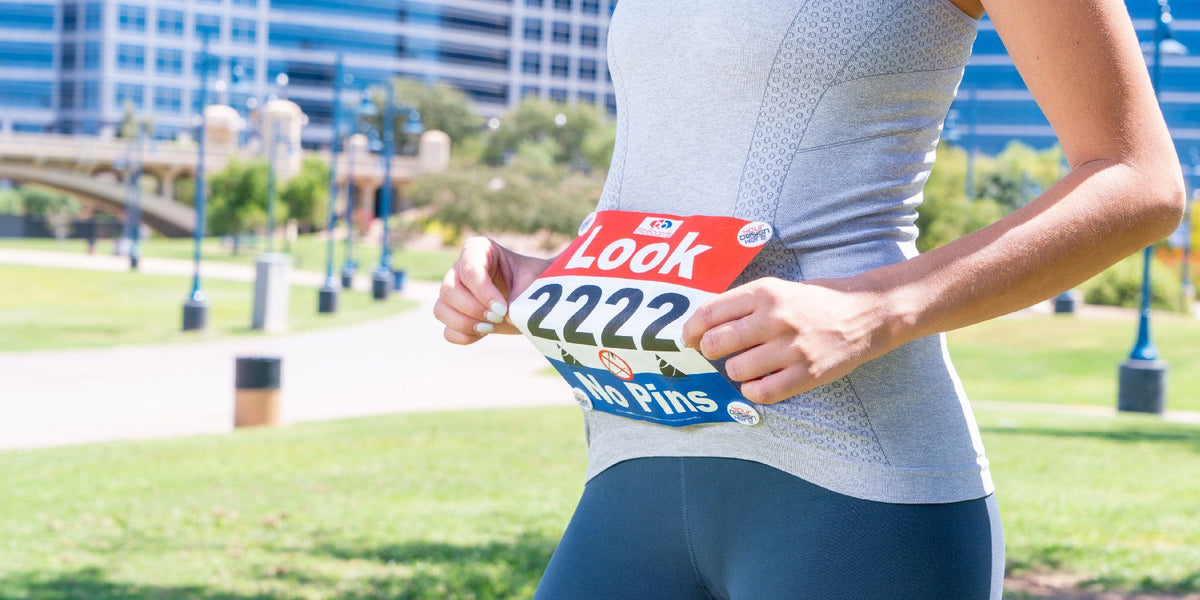
Why it beats the others: nothing is pierced, so there are no holes and no torn bib, and because you fasten all four corners there is no pivot point for the bib to rotate around. There is no metal and no magnet, so chip timing is unaffected. They pop off in a second and go in your bag for the next race.
The honest downside: you have to buy them, and you have to remember to bring them. A set is four pieces and does one bib.
Browse bibSNAPS, or read how the pin-free system works.
2. Race belt
An elastic belt with toggles that hold the bib. The bib never touches your shirt, so there is nothing to damage.
Good for: triathlon, where the bib has to face backwards on the bike and forwards on the run, and you cannot stop to repin in transition.
Less good for: road running. The bib sits at the waist rather than the chest, it rides up when you tuck a gel behind it, and it can rotate around your body. Some races also specify the bib must be visible on the front of the torso.
3. Magnetic bib holders
Strong magnets sandwich the bib and the shirt between them. Fast, no holes, and popular for good reason.
The problem is chip timing. Many race bibs carry the timing chip as a foam-backed tag on the reverse of the bib. Putting a strong magnet directly against that area is a risk, and the failure mode is invisible: you find out you have no chip time when the results are posted. Some race directors now specifically ask runners not to use magnets.
There is a second, smaller issue. On very thin singlet fabric, the two magnet halves can slide against each other rather than staying put.
We wrote a fuller comparison at race bib magnets versus bibSNAPS.
4. Bib clips and toggles
Plastic clips that grip the bib and the fabric together. No holes, cheap, reusable.
The catch is fabric dependence. A clip that holds firmly on a mid-weight tech tee can slip on a thin singlet or fail to close over a thicker long sleeve. Grip comes from spring pressure alone, and pressure that is comfortable is often not enough on race day.

5. Tape
Duct tape, kinesiology tape or packing tape across the bib corners.
It is free, and it will get you through a dry parkrun. It fails predictably in rain, in heat, and after twenty minutes of sweat, and it can leave adhesive residue on technical fabric that never fully washes out. Fine as an emergency fix at the start line, not a plan.
6. Sewing the bib on
Included for completeness. It works, it is very secure, and no one is doing this for a Saturday 10K. If you are running a goal race in a one-off custom kit and you have an evening spare, it is an option.
What race directors should hand out instead
If you are on the other side of this and you are the one putting pins in five hundred packets, the calculation is different. Pins cost almost nothing per runner, but they generate complaints, they damage the technical shirts you paid to have printed, and they are an unbranded throwaway.
A branded fastener is a piece of kit runners keep and reuse at their next race, with your event or your sponsor's logo on it. That is why sponsors like them: the exposure does not end at the finish line. Custom bibSNAPS start with a free digital proof within 24 hours, and bulk pricing goes down to $3.49 a set. If you print your own bibs as well, we do those on tear and water resistant Tyvek: custom race bib numbers.
Frequently asked questions
What is the best alternative to safety pins for a race bib?
A snap-and-lock fastener. It is the only option that removes the holes, removes the pivot point that makes bibs flap, carries no chip-timing risk, and is reusable across seasons.
Are magnetic race bib holders safe?
They are safe for your clothing but they carry a risk with chip timing, because many bibs have the timing chip mounted on the back of the bib itself. Some race directors ask runners not to use them for this reason.
Can I attach a race bib without anything at all?
Only with a race belt, which holds the bib independently of your clothing. Everything else needs some form of fastener.
Do race organisers allow alternatives to safety pins?
Almost always yes. The requirement is that your bib number is visible on the front of your body and that the timing chip is not obstructed. How you attach it is up to you.
How much do bib fasteners cost?
Around $10 to $12 for a set of four, which attaches one bib and lasts for years of racing. Bulk and custom pricing for events goes considerably lower.
Will a bib fastener damage my race bib?
Snap-and-lock fasteners do not pierce the bib, so it comes off intact if you want to keep it. Pins are the usual reason kept bibs have torn corners.

Leave a comment
This site is protected by hCaptcha and the hCaptcha Privacy Policy and Terms of Service apply.