

If you have ever crouched over your race bib in a dark parking lot at 5 a.m., fumbling four safety pins into place with cold fingers, you have used a fastening method that has not changed much since the 1970s. Pin a bib, run a race, throw the pins away (or lose them somewhere in the corral). It works, but “it works” is a low bar for something runners do at nearly every event, every season, for decades.
So why are safety pins still the default, and is there a better way? Here is what is actually going on with race bib fasteners, and why more runners and events are switching to reusable ones like bibSNAPS®.
A fastener that has not caught up with the sport
Most race bibs are still attached the same way they were fifty years ago: four safety pins, one at each corner. It is cheap, it is simple, and every packet pickup table has a bucket of pins ready to go. But running has changed a lot since the 1970s. Technical fabrics, GPS watches, race photography, sustainability commitments — nearly everything about the sport has been upgraded except the thing holding your number on your chest.
What all those pins add up to
Do the math on a single event and the numbers get big fast. A 10,000-runner race using the standard four-pin setup puts roughly 40,000 small metal pins into circulation in one morning. Scale that up to a major marathon and it gets more striking. The 2025 TCS New York City Marathon had 59,000 finishers. At four pins each, that is 236,000 safety pins for a single race, most of which end up tossed, lost, or stepped on before the first mile.
Multiply that across a full race season and you start to see why more race directors and runners are asking whether there is a better default.
Why runners are moving away from pins
A few things about safety pins have always been minor annoyances. Together, they add up to a real reason to switch.
They can puncture more than fabric. Any pin that slips while you are fastening it, or works loose mid-race, breaks the skin. The CDC notes that puncture wounds, especially ones exposed to dirt or sweat, carry an elevated risk of infection, including tetanus. It is a small risk with one pin. Multiplied across thousands of runners handling sharp metal in the dark before dawn, it is not zero.
They rust. Standard steel pins corrode with repeated exposure to sweat, rain, and washing, and can leave a reddish-brown stain on fabric. A fastener with no exposed metal pin does not have this problem.
They can trigger nickel allergies. The American Academy of Dermatology estimates that more than 18% of people in North America are allergic to nickel, and most common safety pins are nickel-plated steel. For a meaningful share of runners, that is a fastener working directly against their skin.
They put holes in expensive gear. A safety pin only works by piercing fabric. Four pins means four permanent holes in a $80–150 technical shirt every time you wear it, and a bib that gets caught in the wind can tear the fabric further.
None of these will ruin your race on their own. Together, they explain why a growing number of runners are looking for something better.
What reuse actually solves
The most sustainable fastener is not the one you have to throw away or dig out of a parking lot after the race. It is the one you can use again next weekend. The EPA’s waste management hierarchy ranks source reduction and reuse above recycling, which is exactly the gap reusable fasteners like bibSNAPS® are built to close: fewer pins manufactured, fewer pins in circulation, fewer pins that end up as litter at the finish line.
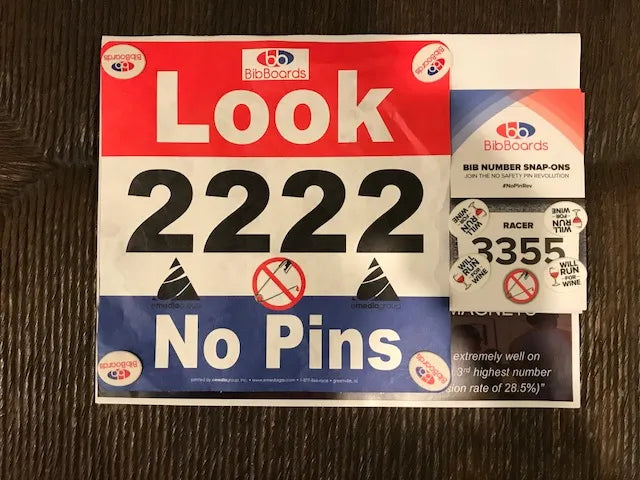
bibSNAPS® are made primarily from a plant-based polymer blend that is reusable, customizable, and recyclable at specialized facilities, with no exposed metal pin to rust, corrode, or trigger a nickel reaction, and no puncture required to fasten your bib in place.
“I started BibBoards because I was tired of watching runners fumble with pins in the dark at 5 a.m., and pin holes in shirts that cost more than the entry fee,” said Brian Goodell, Founder of BibBoards, Inc. “Now bibSNAPS® are trusted by more than 5 million athletes and 500 brands and race organizations. That tells me we didn’t just fix an annoyance, we fixed something the whole sport had quietly accepted for too long.”
Quick takeaway
- Most race bibs are still fastened the way they were in the 1970s: four disposable safety pins.
- A single major marathon can put well over 200,000 safety pins into circulation in one morning.
- Pins carry real downsides: puncture and infection risk, rust, nickel exposure, and permanent holes in your gear.
- Reusable fasteners like bibSNAPS® solve all four without changing how secure your bib feels on race day.
The bottom line
Safety pins have been the default for so long that most runners never stop to ask if there is a better option. There is. bibSNAPS® fasten in seconds, leave your gear untouched, and go right back in your race day bag for the next event instead of the trash. If your bib routine has not changed since the 1970s, it might be time it did. Learn more at bibboards.com.
Putting on your own race? Our 5K planning guide walks through every stage from permits to packet pickup.


Leave a comment
This site is protected by hCaptcha and the hCaptcha Privacy Policy and Terms of Service apply.